
.jpg)

Walk into almost any aesthetic consultation and two topics will come up before anything else: Botox and fillers. They share a category, they are both delivered by injection, and they both contribute to a more refreshed appearance. But that is roughly where the similarities end. These two treatments work through entirely different mechanisms, target entirely different concerns, and produce results that serve very different purposes.
Understanding how each one works is not just useful trivia. It changes how you approach your own care, helps you ask better questions during a consultation, and ultimately leads to results that actually match what you were hoping for. At Kalos & Muse, we spend a significant portion of every consultation on this exact explanation, because an informed client always gets a better outcome.
Two Treatments, Two Completely Different Problems
The most useful starting point is this: one treatment targets movement and the other targets volume. That single distinction explains nearly everything about when each one is appropriate and what it can realistically achieve.
Botox works by temporarily interrupting the signal between a nerve and the muscle it controls. When that signal is blocked, the muscle cannot contract with its full force. Over time, repeated contractions are what etch lines and creases into the skin. Soften the contraction and you soften the line. The result is a smoothing of what are called dynamic wrinkles: the kind that appear specifically when your face is in motion and gradually become permanent as the skin loses its elasticity with age.
Dermal fillers operate through a completely different principle. Rather than affecting muscle activity, they physically restore structure and fullness to areas where volume has diminished. The face loses fat, bone density, and soft tissue support over time, and that loss shows up as hollowness, flattening, and a general deflation of features that once appeared more defined. Fillers replenish what time has gradually taken away.
One treatment quiets movement. The other restores structure. Once you understand that distinction, you start to see why so many clients benefit most from a combination of both rather than one or the other in isolation.
Where Botox Works Best
Because Botox targets movement-related changes, its most effective applications are concentrated in areas of the face with the highest muscle activity. The upper face is where most clients begin.
The horizontal lines that develop across the forehead from raising the brows repeatedly over decades are a classic Botox area. So are the vertical creases that form between the brows when you concentrate, squint, or feel frustrated. The fine lines that fan outward from the outer corners of the eyes, deepened by years of smiling and squinting, respond particularly well to precise Botox placement in that area.
Beyond these core zones, skilled providers use Botox in more nuanced ways: subtly elevating the arch of the brow, softening the vertical bands that can appear in the neck, reducing the prominence of a squared jaw in clients who grind their teeth, and even addressing excessive sweating in certain areas. The range of applications has expanded significantly as injector training and technique have advanced.
Timing is worth understanding too. Botox does not produce visible change the moment it is administered. The muscle relaxation develops gradually over the following week or so as the protein takes effect, with the final result settling in around 10 to 14 days post-treatment. Most clients find their results hold well for three to four months before a touch-up makes sense, though this varies based on individual metabolism and the specific muscles involved.
Where Fillers Fit In
Fillers take on the structural and volumetric concerns that Botox simply cannot address. When the issue is not a wrinkle created by movement but a change in the shape or fullness of a feature, filler is the more appropriate tool.
The mid-face is one of the most common areas for filler treatment. As the cheeks lose their natural projection and support with age, the whole face can begin to look heavier at the lower third because the upper third has deflated. Restoring volume through precise filler placement in the cheek area lifts and repositions the face in a way that no topical product or muscle-relaxing treatment can replicate.
The lip area is another high-interest zone, both for clients wanting subtle definition as their natural lip border softens and for those seeking a modest increase in volume. Skilled lip filler is about proportion and symmetry, not size. Well-placed lip filler in the right amount looks like a better version of your existing lips, not an obviously treated one.
Under the eyes, hollowness and shadowing that develops with age can be addressed with filler in a technique called tear trough treatment. The jawline and chin are also popular areas for filler-based contouring, particularly for clients who want more definition without surgical intervention.
Most fillers used today are formulated with a substance that your body already produces and recognizes. Results are visible almost immediately following the appointment, with any minor swelling resolving over the following few days to reveal the final outcome. Longevity varies by product and location: areas with less movement tend to maintain their results longer, while highly mobile areas like the lips may need refreshing sooner. Most clients plan a touch-up somewhere between six months and two years depending on the specific treatment.
How to Think About Combining Both
The most natural-looking and comprehensive results in aesthetic medicine almost always come from addressing both movement and volume together. Using Botox alone on a face that has also lost significant volume can make the skin appear smoother but flat. Using fillers alone on a face where dynamic lines are prominent addresses structure but leaves the movement-related etching intact. Together, they create a result that is balanced and genuinely refreshed rather than altered in any one obvious direction.
A thoughtful provider will assess your face as a whole before recommending either treatment. They will look at where volume has shifted, which areas show the most movement-related change, what your natural proportions are, and what results would look authentically like you rather than like a generic aesthetic outcome. At Kalos & Muse, this whole-face approach is central to how every injectable consultation is conducted.

What Happens During and After Your Appointment
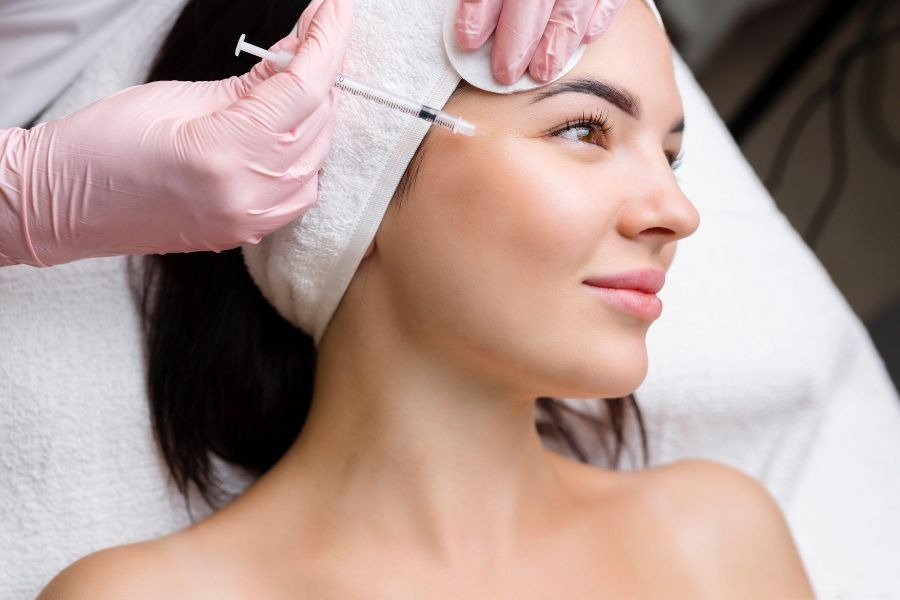
Both treatments are quick in-office procedures. No general anesthesia is involved, and neither requires any preparation beyond arriving with clean skin and sharing your full medical history during the consultation. Most clients describe the sensation during injection as brief and mild, comparable to a small pinch. Topical numbing is available for those who prefer additional comfort, particularly for filler treatments in sensitive areas.
A Botox appointment at Kalos & Muse typically takes under 30 minutes from start to finish. Filler appointments run a little longer depending on how many areas are being addressed. Following either treatment, most clients resume their regular schedule without any meaningful disruption. We do recommend keeping physical exertion light for the first day and avoiding prolonged direct heat exposure for 24 to 48 hours while the treatment settles.
One important note on safety: injectable treatments are only as good as the person administering them. The product itself is only part of the equation. Injection technique, anatomical knowledge, an understanding of facial proportions, and honest communication with the client are what separate genuinely satisfying outcomes from results that miss the mark. This is not a category where the lowest price should be the deciding factor.
Is One Right for You, or Both?
The clearest way to think about it: if your primary concern is lines that appear when you make expressions, Botox is worth exploring. If your concern is a loss of fullness, definition, or structural support that shows even when your face is completely at rest, filler is the relevant conversation. If both are present, which is very common for clients in their mid-30s and beyond, a combined approach will likely serve you best.
The most important step is a consultation with a provider who takes the time to understand your specific anatomy and your specific goals, not someone working from a one-size-fits-all menu. Every face is different. Every result should reflect that.
To learn more about the full range of injectable services we offer at Kalos & Muse, visit our injectables page. If you are brand new to professional aesthetic treatments and want to understand what the full experience looks like from start to finish, our post on what to expect from your first facial or laser treatment is a helpful starting point. And for clients who want to support their injectable results with a strong skincare foundation, our skin rejuvenation services are designed to complement and extend what injectables achieve.
Book a consultation at Kalos & Muse to talk through your goals with one of our injectable specialists. We will walk you through your options clearly, answer every question honestly, and build a plan that is right for your face, your timeline, and your life. Visit kalosmuse.com to schedule.
Tags: Botox, Dermal Fillers, Injectables, Medspa, Anti-Aging, Facial Rejuvenation, Richardson TX, Kalos & Muse